The Green Sweat Bees- Identification Tips

I see many pictures of bees and a common sight among those are the green sweat bees. What most people probably don’t realize is that there are 4 different genera of green sweat bees here in the U.S. At first glance they might all look alike but there are some key differences among them. This post will show you how to tell the difference between all 4 though keep in mind not all these traits are easily seen just from photos.

Agapostemon:

Larger species, males have black and yellow abdomens and are easy to ID to genus, the second picture is of a male. The females of most species are all green and look similar to the other Genera. The easiest trait to look for is the VERY prominent rim surrounding the propodeum.

agid
image2 (1)

Augochloropsis:

Larger species. The best way to ID is by looking at the tegula (where the wings attach to the body). The tegula is “D” shaped and has the metallic green covering.

augochloropsis

Augochlorella:

Extremely similar to Augochlora and the best and easiest way to tell them apart is by looking at the face. When you compare the two pictures side by side you can see the difference quite easily. In Augochlorella there is no lobe that extends down and is just a simple right angle.

augochlorella

Augochlora:

In Augochlora there is a lobe that extends down onto the clypeus that is clearly seen in the photo.

augochlora
I hope this post was able to help you out and you found it useful. If you have any question feel free to contact me.

Bumblebees Get Their Unit Trays

I took some time this past weekend to do some work on the collection. I decided to move all the bumblebees into their own unit trays so they can be ready to go into the new drawers that are coming in the mail. The first step before all of this was to sort through and ID all the specimens I have labeled so far.

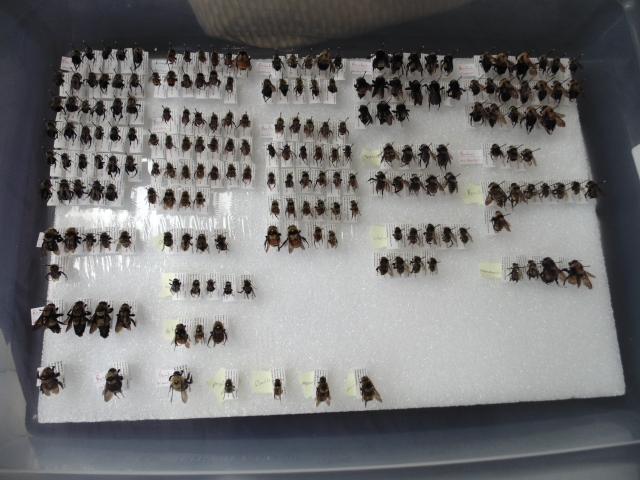
The end result of sorting and ID’s was this slab of styrofoam, which as you can see has the specimens grouped into their respective species, totaling 24 species.

dsc01961

The next thing I did was assemble the unit trays. Instead of regular trays I buy the folding unit tray kits. The downfall is that I have to put them together myself but they are cheaper in the long run than buying a whole bunch of regular trays at a time. When all is said and done they still look nice and tidy when all complete and I’ve always liked using them.

dsc01962

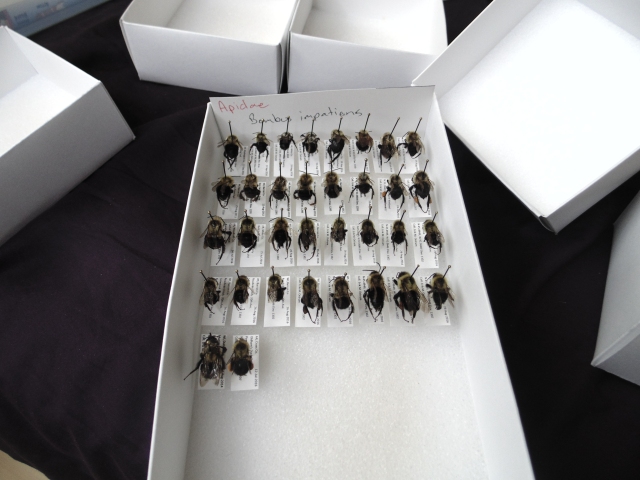
All that’s left to do is putting the bees into the trays. Here is a finished tray of Bombus impatiens. You can see the labeled card telling me what’s in the tray. I created a label card for each species which requires much measuring and cutting.

dsc01963

Finally after a bit of time I finished. These trays are now ready to be put into some Cornell Drawers which will be arriving in a couple days. Now that I’m finished with all the bumblebees, its time to move on to the sorted and ID’ed Lepidoptera.

dsc01964

Revision of the genus Tetramorium

Across much of the U.S. ant wars are commonly seen taking place on sidewalks and are always a spectacle to behold. This ant is in the genus Tetramorium but confusion on the exact species persisted for many years. It was also introduced from Europe which has a few different species in the genus.

At first it was placed as the species Tetramorium caespitum but that was eventually changed and it was then known as Tetramorium sp. E for a decent period of time. Finally in 2017 a paper was published that shed light on the subject and finally settled the matter. T. caespitum was confirmed as a species but it was still only in Europe. They raised Tetramorium immigrans to species level and assigned this name to the North American specimens and finally ended the long road of confusion.

So now when you see the pavement ant wars while on your walk you can say those are officially Tetramorium immigrans.

Article:

Herbert C. WAGNER, Wolfgang ARTHOFER, Bernhard SEIFERT, Christoph MUSTER, Florian M. STEINER & Birgit C. SCHLICK-STEINER just published “Light at the end of the tunnel: Integrative taxonomy delimits cryptic species in the Tetramorium caespitum complex (Hymenoptera: Formicidae)”. Myrmecological News 25: 95-129 Vienna, October 2017

https://www.researchgate.net/publication/322663055_Light_at_the_end_of_the_tunnel_Integrative_taxonomy_delimits_cryptic_species_in_the_Tetramorium_caespitum_complex_Hymenoptera_Formicidae