Actias luna (Linnaeus)

This species is probably one of the most beautiful moths found in the eastern U.S. I’ve been extremely fortunate to encounter luna moths rather regularly growing up in Wisconsin. Their large size coupled with the green coloration makes this species easily identified and admired.

This is one of the more common Saturniidae species found throughout the eastern U.S. The life cycle is similar as other giant silk moths here in the U.S. The caterpillars can be found on a wide variety of plants including birch, sweet gum, and walnuts among many others. Like other silk moths the adults do not feed and only live for a very short time.

Even though I live in Colorado now and out of range of the luna moth I still vividly remember always seeing them growing up. I currently have a handful of specimens, mostly from Wisconsin but also from Arkansas.

DSC01436

Other Online Sources:

https://www.butterfliesandmoths.org/species/Actias-luna

https://bugguide.net/node/view/562

Papilio canadensis Rothschild & Jordan

This was one of the most common swallowtail species I saw while growing up in northern Wisconsin. To tell the truth up until I was in about 6th grade I always thought it was the similar Papilio glaucus I was seeing. My mind was blown when I found out it was a different species entirely.

This species is mostly found in the upper Great Lakes states and the northeastern states into Canada and up to Alaska. Because of this most people in the U.S. are outside of the range of this species.

They are in flight from May to about mid-July. Caterpillars can be found feeding on leaves of birch, aspen, and black cherry among others.

DSC01973

All specimens I have in my collection were collected in northern Wisconsin. Eventually I want to add specimens from the northeastern states as well.

DSC01974

Other Online Sources:

https://www.butterfliesandmoths.org/species/Papilio-canadensis

https://bugguide.net/node/view/7367

Papilio eurymedon Lucas

This is a pretty and quite striking butterfly species. The creamy white color of the wings contrast sharply with the dense black markings and borders. It looks like the tiger swallowtails but lack the yellow color on the wings.

This species is relatively common and found throughout much of the western U.S. I’ve encountered a good amount of individuals along the Front Range of Colorado.

You can typically find this species on the wing from April-July in much of its range, though it flies longer in southern California. The larvae feed on a variety of woody plants including cherry, and ash among others.

DSC01977

I currently have a few specimens in the collection. Most are from northern Colorado. I’m hoping to get some more specimens from areas throughout the state.

DSC01978

Other Online Sources:

https://bugguide.net/node/view/40208

https://www.butterfliesandmoths.org/species/Papilio-eurymedon

Parnassius smintheus Doubleday

Ever since I’ve moved to Colorado I’ve seen some beautiful species and I like them all. One of my favorites though would have to be Parnassius smintheus. I’m actually not entirely sure why I like this species so much, I just do.

Some people think this is the same species as the European Parnassius phoebus, others separate them and other have 3 different species occurring in North America. Needless to say it can get confusing and different depending on who you talk to.

DSC01521

This species can be found in the Rocky Mountains in the summer months. Caterpillars can be found feeding on species of Stonecrop. I haven’t found any caterpillars yet but I’ve seen a few adults, which are quite easy to ID while they are flying (in my opinion). I didn’t realize how large these butterflies actually were until I saw one in person.

DSC01985

As you can see it is a nice crisp white color on the wings with contrasting black and red. The underside of the wings just mirror the top just not as pronounced black and red. I’m hoping to get a couple more specimens from some new locations this summer.

DSC01986

Other Online Sources:

https://bugguide.net/node/view/24000

https://www.butterfliesandmoths.org/species/Parnassius-smintheus

Antheraea polyphemus (Cramer)

This species was the most common Saturniid I encountered growing up in Wisconsin. Seeing one was always a treat as were the other species of Saturniidae. I remember on one particular fruitful blacklighting session back in 2012 we had 5 of them show up, which for Wisconsin, I consider pretty good.

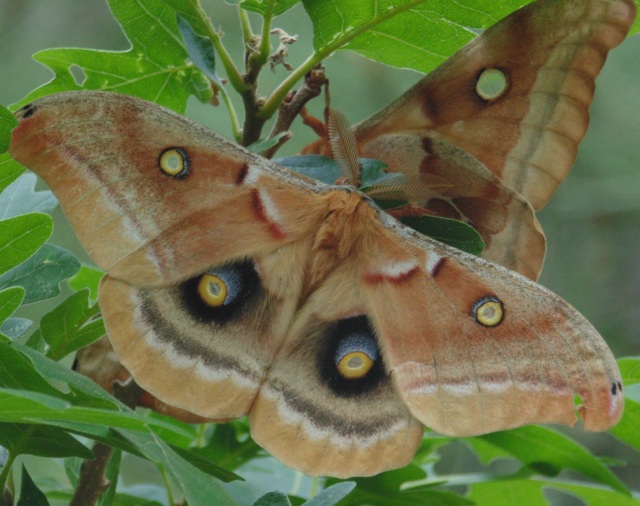
This is a large species that can have a wingspan of up to 6 inches. The overall tan color is distinctive and contrast with the dark coloring surrounding the eyes on the hindwings. This is a common species found throughout the eastern U.S. and also has scattered records throughout the western states as well. The pair in the photo below were found in Colorado Springs, CO. I didn’t collect them as they were in the midst of mating.

dsc00676

One of the things I’ve always been amazed at is the size of the caterpillars and the life cycle which takes 1 year. The adults eclose in the spring and only live about 1 week as they don’t have mouthparts to feed. The caterpillars hatch and feed throughout the summer and early fall and then they pupate and over-winter.

I have a handful of specimens, all collected from Wisconsin.

dsc01433

Other online sources:

http://entnemdept.ufl.edu/creatures/MISC/MOTHS/polyphemus_moth.htm

https://bugguide.net/node/view/427

https://www.butterfliesandmoths.org/species/Antheraea-polyphemus

Alypia octomaculata (Fabricius)

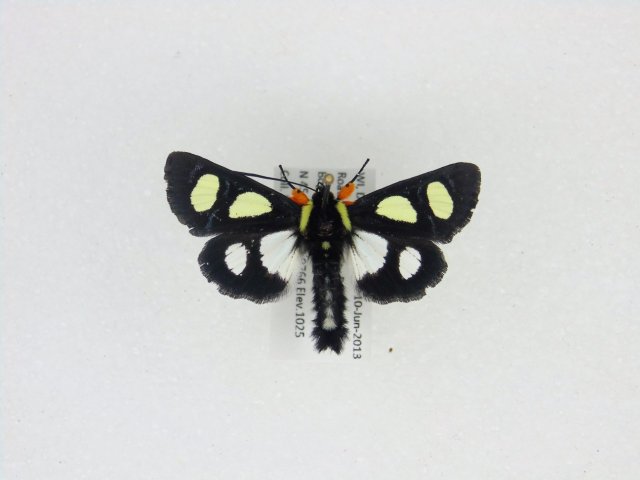
This is a species that is always a treat to see. I was fortunate to see this species relatively often growing up and continues to bring me some sort of nostalgia every time I see one. The contrasting black and white coloration along with the orange legs makes this species a real beauty.

This species ranges throughout the eastern U.S with some scattered records in some western states. There are some other species that look similar so depending on the location you might need to double check to make sure you have this species. Though this is usually only true in the western and more northern parts of its range.

28061821_10215638326212262_2070763998629675373_o

Larvae can be found feeding on grape and Virginia Creeper. Adults are actually day flying as well and are often found taking nectar at various plants.Even though this species isn’t large by any means it is steal an eye popper and adds some color to the Noctuidae drawers. I have only a handful of specimens in the collection, all being from Wisconsin. I’m still on the hunt for some western specimens.

Other online sources:

https://bugguide.net/node/view/485

https://www.butterfliesandmoths.org/species/Alypia-octomaculata

Limenitis weidemeyerii W. H. Edwards

This is a very bold colored species belonging in the same genus as the more commonly recognized Viceroy. The Limenitis genus as whole are all quite bold and colorful. I never seen this species until I moved out to Colorado and now it has become the most recognizable species I see flying about.

dsc01622

This species ranges throughout the Rocky Mountains here in the U.S and several subspecies are recognized. Larvae can be found feeding on aspen, cottonwood, and willows among others.

Since 2017 I’ve been able to add a few individuals to the collection, all from Colorado. As of right now I only have a handful of species and subspecies of Limenitis and I’m hoping to add some more variants soon.

Below you can see the bold coloration on the underside of the wings, which is my favorite part of this species.

27993464_10215638333492444_7750553528662639932_o

Other online sources:

https://www.butterfliesandmoths.org/species/Limenitis-weidemeyerii

https://bugguide.net/node/view/24571

Anaea andria Scudder

I was always fascinated with this species growing up after seeing some framed specimens. My chance to see one finally came when I was doing research in Arkansas. I was able to see quite a few individuals and managed to collect a few as well. I recently was able to get another individual from south Texas as well.

This is a widespread (though somewhat sporadic) species in the southern states but doesn’t really get noticed much. This is thanks in part to the excellent cryptic coloration of a dead leaf. This species is also known to have summer and winter forms, which unfortunately the collection is missing the winter form.

The collection currently holds a handful of specimens, mostly from Arkansas but also one individual from Texas.

28238051_10215638322172161_5953671733221524564_o

Other online sources:

http://entnemdept.ufl.edu/creatures/bfly/goatweed_bfly.htm

https://www.butterfliesandmoths.org/species/Anaea-andria

https://bugguide.net/node/view/13806

Xylophanes tersa (Linnaeus)

I’ve only encountered this species once while I was working in Arkansas. Luckily I was able to catch it for the collection. I was out collecting around the light pole and security light when this individual came flying in. I was really excited to be able to get a new species to the collection.

dscn2063

Xylophanes tersa can be found throughout much of the eastern U.S though its much more common in the southern states as it migrates north every year. This is an unmistakable species so getting a correct ID should be really easy. The abdomen is extremely pointed and it has a very streamline body. The hindwings have very contrasting black and yellow/white markings.

Caterpillar host plants include smooth buttonplant, starclusters, catalpa plus a few others.

Currently there is 1 specimen in the collection collected in eastern Arkansas.

dsc01438

Other Online Information:

https://bugguide.net/node/view/419

https://www.butterfliesandmoths.org/species/Xylophanes-tersa

Automeris io (Fabricius)

I’ve only managed to see this species twice in my life. Once when I was young and then again in the summer of 2017 when I moved to Colorado. I was honestly quite surprised because I had no clue this species ranged into Colorado at all but as it turns out, it does. dsc00632

The genus Automeris is quite speciose having around 145 species. Here in the U.S we have only 7 species with just A. io being widespread. 5 species just barely make it in the southwest and there’s one species found in the coastal salt marshes in areas of the gulf coast.

Automeris io is a member of the family Saturniidae (Giant Silk Moths) and can be found throughout  the eastern U.S and into Colorado. This species is easily identified from the very conspicuous eye spot on the hind wings and quite frankly its unmistakable.

This species has a bit of range in terms of host food plants including maple, poplar, willow, and elm to name a few.

Currently in my Collection I have one specimen collected in Colorado

28235191_10215638321452143_6492148628661588103_o


More information can be found online:

http://entnemdept.ufl.edu/creatures/misc/io_moth.htm

https://www.butterfliesandmoths.org/species/Automeris-io

https://bugguide.net/node/view/405