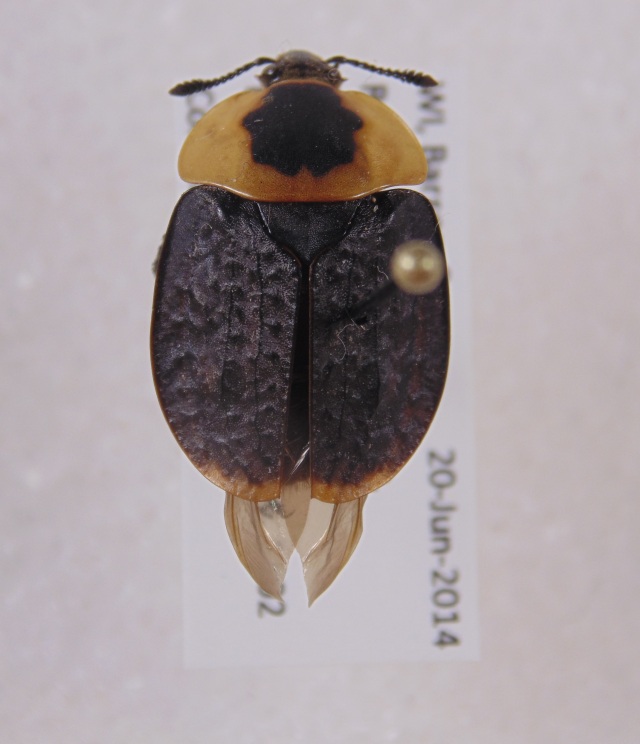
Necrophila americana (Linnaeus)

A great but severely underrated place to look for insects is on dead animals. I’ve found many cool species and attracts many you may only find of carrion. If you are looking for member of the family Silphidae then carrion is a great spot to start you search. One species I’ve commonly found is Necrophila americana. 

This beetle is pretty distinctive and easy to spot. It’s large size mixed with the yellow pronotum makes it hard to miss. This species prefers moist woods and is more commonly found on larger carrion. I’ve found it multiple times on deer as well as fish. The adults actually mostly eat the maggots that are feeding on the carrion.

This species is found throughout the eastern U.S up though eastern Canada. So far I’ve been able to collect a decent number of specimens from mostly Wisconsin and Arkansas.
necrophilaamericana

Other online sources:

https://bugguide.net/node/view/6744

https://mlbs.virginia.edu/organism/necrophila_americana

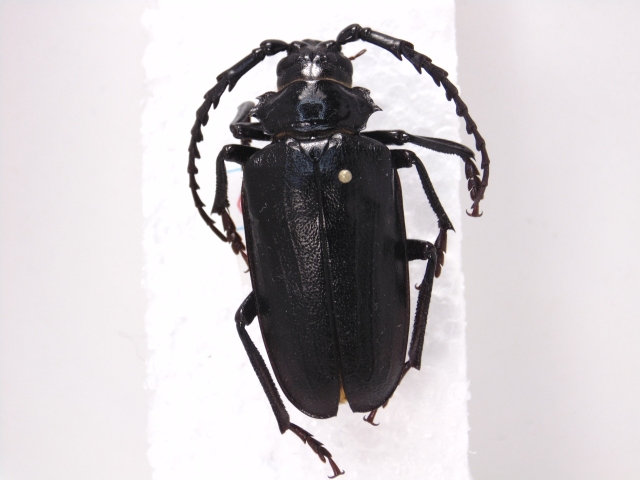
Prionus californicus Motschulsky

This is a large robust beetle found in the western U.S. This is actually one of the largest beetles in the collection currently and though it has no bright colors, it is still a beautiful and impressive beetle.

I would call this a long lived species, having a life span of 3-5 years…though granted most of that is spent as a larvae underground. Larvae feed on a wide variety of plant roots and at times can cause infestations.

One of my favorite aspects of this species are the saw-toothed antennae which, in my opinion, really what makes this species so cool.

I currently have a single specimen collected from Colorado in the collection. It is actually one of only a couple specimens of Prioninae currently in the collection so I’m really hoping to collect more.

dsc01957


Other online sources:

https://bugguide.net/node/view/18882

http://jenny.tfrec.wsu.edu/opm/displayspecies.php?pn=643

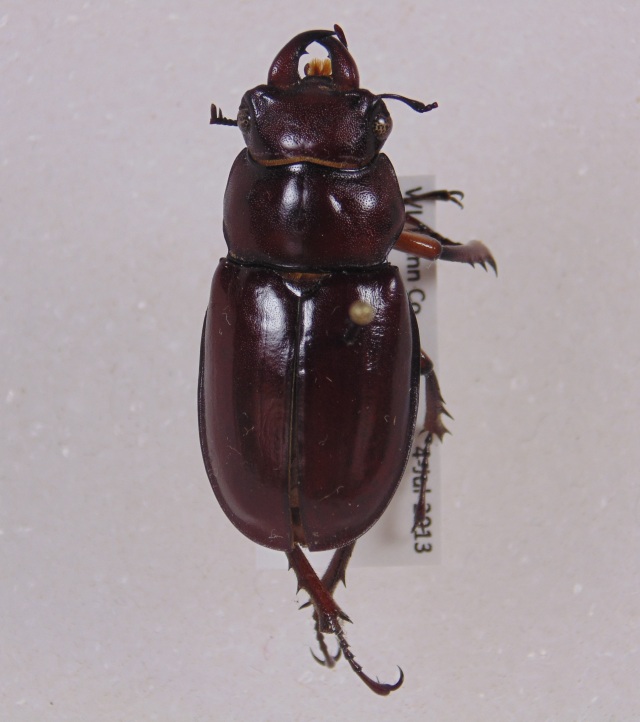
Lucanus placidus Say

Another of the stag beetle species found in the U.S. It’s around the same size as Lucanus capreolus but lacks the bicolored femurs and has multiple teeth on the mandibles instead of one like in L. capreolus.

This species can be found in the midwestern states from southern Canada down to Texas. I collected the single specimen I have in northwestern Wisconsin in the same general area where I also collected L. capreolus.

Like other stag beetles adults can be found at lights at night and larvae can be found in decaying logs and stumps.

lucanus placidus

Lucanus capreolus (Linnaeus)

One of the handful of stag beetle species in the U.S. Though not as impressive as Lucanus elaphus it is still a large sized species. The mandibles on the males don’t get very large but are still noticeable

This species can be found throughout the eastern U.S. and north to southern Canada. This was actually the first stag beetle species I collected in Wisconsin when I still lived there. The best way to tell this species apart from the others is the bicolored femora.

It can be found in deciduous forests as well as parks. Larvae can be found in rotting logs and adults can be found on sugar baits, sap, and can be found at lights.

lucanus capreolus

Other online sources:

https://bugguide.net/node/view/3107

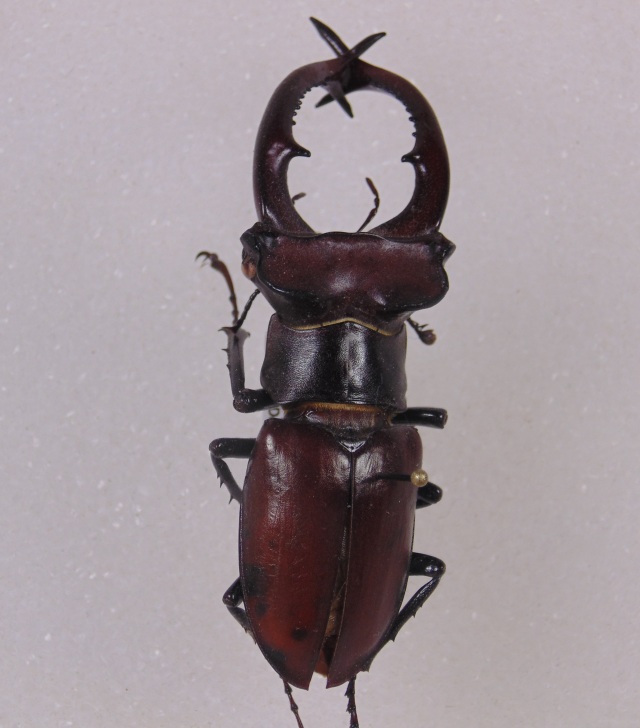
Lucanus elaphus Fabricius

One of the most impressive beetle species found in the U.S. would have to be Lucanus elaphus…..aka the giant stag beetle. Though North America isn’t particularly rich in stag beetle species, this is one that rarely fails to impress. This is actually a species I have never seen alive in person, my friend and roommate back in my college days collected the specimen while he was in North Carolina.

Males of this species are unmistakable while females can be confused with the couple other species present in the same range. Larvae feed and can be found in moist decaying wood while adults can feed on plant juice and rotting fruit.

This species can be found in the eastern U.S and can be found at lights at night. Though having a more widespread range, there is some concern surrounding conservation status.

Currently in the collection I only have one male specimen. It is always an attention getter and people are always amazed at the size of both the mandibles and the specimen as a whole.

lucanus elaphus

Other online sources:

https://bugguide.net/node/view/3105

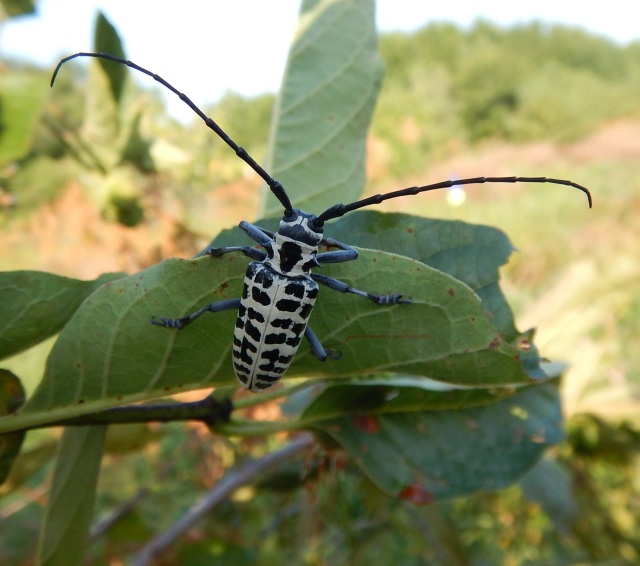
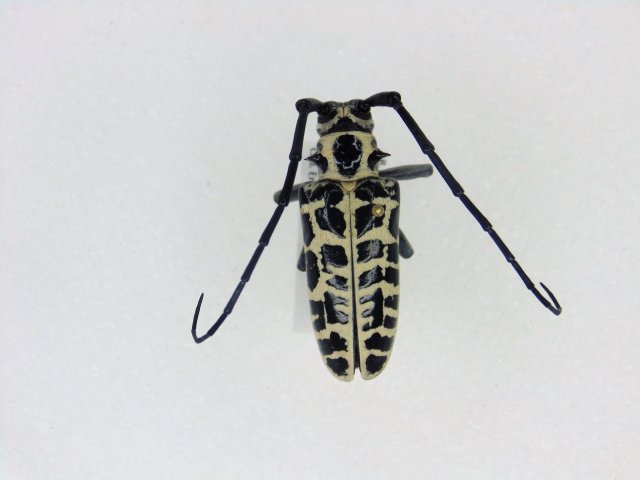
Plectrodera scalator (Fabricius)

The first time I saw this species I was completely taken aback by the both the size and bold coloration. I was able to encounter quite a few while working in the wetlands of eastern Arkansas. Impressive just sitting there as well as flying.

cborer

This is an unmistakable species marked in black and white coloration. This is a relatively widespread species commonly found in more wet areas where is can be found feeding on poplars, willows, and cottonwoods. There have been cases where this species has become a pest on the trees that its larvae feed on.

When people want to see some of my favorite species in the collection this species tray is always one of the ones I pull out and people are always in awe of them. I was able to collect a few specimens for the collection, all from Arkansas.

28161981_10215638320892129_5821679056818469216_o

Other online sources:

https://bugguide.net/node/view/7956

http://entoweb.okstate.edu/ddd/insects/cottonwoodborer.htm